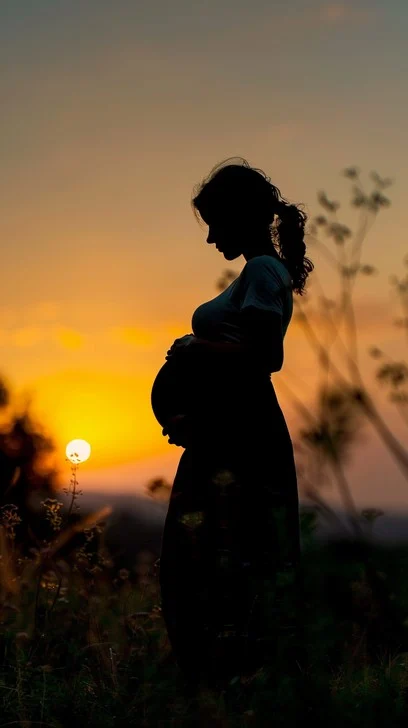
I want my baby.
These are the words I find myself repeating silently as I zone out during conversations with friends or family. Often, the discussions revolve around mundane topics like a tough day at work, the latest binge-worthy series, or amusing anecdotes that spark laughter. Other times, they touch on more significant issues, such as a breakup, a serious illness, or pressing global events. Yet, regardless of the subject matter, my inner refrain remains the same: I want my baby. I want my baby. I want my baby.
My baby passed away on 3/3/2020—almost exactly a year ago. At that time, I was over eight months pregnant, had just acquired a new home, was thriving in my dream job, and had a partner whom I recognized as my future husband after just one encounter at 19.
As the first anniversary of Ava’s delivery approaches, certain aspects of my life have changed compared to last year; my body somewhat resembles its former self (somewhat—because, well, pregnancy), I’ve returned to work, and when grocery store clerks inquire about my well-being, I respond with a bright, “I’m well, how about you?”
In many ways, life appears different now—but in countless others, it remains the same. Sleep eludes me, I find myself crying daily (not all day, but at some point each day), and frequently, I sit in silence, shaking my head as I process the events of the past year. Yet, one constant persists—the deep longing for my baby who should be here but isn’t.
I recall others’ shock upon learning of my loss—genuine disbelief that I would need to go to the hospital to deliver her. It seems many assume that when a loss occurs, the baby simply disappears, but that is far from the truth. Pregnancy doesn’t just vanish when a baby doesn’t survive. Babies must be delivered, whether the loss occurs early (sometimes vaginally at home or through medical intervention) or during late-term losses, typically requiring labor induction (the same process that friends endure to bring home their healthy babies).
On 3/4/2020, I entered the women’s hospital for my scheduled induction. In the waiting area, I sat across from expectant mothers, their excitement palpable.
I will never reclaim this experience, I thought, as stuffed animals, balloons, and rounded bellies surrounded me.
This will always be my first delivery—the one I envisioned long before I was married or even seriously considered having children, though I never imagined it would unfold this way.
After checking in, I was escorted to my room, which was spacious with a private bathroom and appeared newly renovated. Directly opposite the bed, a baby warmer was mounted on the wall, its interior lined with a blanket adorned with colorful handprints. Not wanting a constant reminder of what lay ahead, I asked my husband, Alex, to have it removed.
“They need a place to put her body,” he gently reminded me, though they agreed to move the warmer closer to the door, out of my sight.
The nurse directed me to the bed, where a green-printed hospital gown awaited me. I slipped into the gown in the private bathroom, catching a last glimpse of my pregnant belly in the mirror.
Dressed in my new attire, I waddled back to the bed, where a stack of intake forms awaited my attention.
“You’re about to experience one of life’s most special joys,” read the first form—a cruel oversight given my circumstances.
“Will you accept blood if a transfusion is necessary?” a nurse asked as I submitted the completed forms.
“Yes,” I replied, thinking, I won’t need that; a red hospital band was fastened around my wrist.
Induction began just after 9 PM, lasting an agonizing 48 hours. During this time, family members filtered in and out, while Alex took up residence on a couch that was ill-suited for his tall frame.
Multiple providers inserted hands, medications, and instruments deep within me. My body resisted fiercely, as if to plead, “No, please no.” I want my baby. I want my baby.
But neither I nor my body had a say in the outcome.
With a balloon for dilation and an amniotic hook that broke my water, active labor commenced. Alex held a plastic bag to my face and a cool washcloth to my forehead as I lay feverish, sweating, shaking, and vomiting.
Pelvic pressure surged as the nurse positioned my numb legs back in the stirrups. Alex held my hand, and after one push, I managed to voice the question that haunted me, “Is it over?”
“That’s it, it’s over,” my doctor said, leaving with her in his arms, still.
It was 8:53 PM on 3/6/2020, and the silence was deafening.
Cleaned and bundled in a soft blanket, with a delicate pink hat adorning her tiny head, she was placed in my arms. I held her tightly, determined to absorb every detail—determined to know her; determined to love her—determined to be her mother. I wanted to remember everything about her—how she looked, how she felt; I knew my time with her was precious and fleeting.
She weighed 4 lbs, 12 oz and measured 17 ¾ inches. She had an adorable nose and full lips. She was my baby—the one I carried for eight months, created with the love of my life.
Once the medical team exited to allow us some time alone, we shared 20 minutes filled with music, tears, and passing her back and forth, until Alex grew alarmed.
“You’re bleeding a lot. I don’t think that’s normal.”
Alex rushed to find help while I remained in bed, holding her close.
In a flurry, the doctor quickly scrubbed in, and my legs were placed back in stirrups, as my baby was taken from me.
I want my baby. I want my baby.
As the medical team assessed the situation, I watched blood pour from my body, soaking the hospital linens red. They hastily disconnected the bed from the wall, and Alex leaned down, planting a soft kiss on my forehead. I heard his shaky voice, “I love you,” before they wheeled me toward the operating room.
Once inside, I was laid flat on the table, surrounded by approximately eight medical professionals. They secured a strap over my upper body, confining me as they worked frantically to stop the bleeding.
With four ports for simultaneous blood transfusions, I lay there helpless.
“If we can’t stop the bleeding, we will need to perform a hysterectomy,” someone mentioned.
I’m 29. My baby is gone. I might not survive. If I do, I could be infertile. My mind raced, but I felt an unexpected calm.
I was dissociating as my survival instincts kicked in. My brain was doing what it was designed to do: help me endure.
My thoughts repeated in a monotone voice, “Am I going to die? Am I going to be infertile?”
“We’re doing everything we can for you,” they tried to soothe me, rubbing my arm.
When they realized they couldn’t stop the bleeding, I was transferred to another hospital via an underground tunnel.
Arriving in a new operating room with a fresh team of professionals, the atmosphere was more subdued; there were fewer words of comfort, but they completed the procedure and moved me to the ICU at around 3 AM.
When reunited with Alex, my first question was, “Where’s my baby?” I want my baby.
I was informed I could see her again once stable and transferred to the acute unit.
The following day, approximately 15 hours after delivery, I was finally reunited with her. We tried to make up for lost time, time that can never be regained.
A social worker provided a memory box filled with mementos—locks of hair, footprints, a molded handprint, and pictures taken shortly after her birth. However, the only photos I have of holding her are from the next day.
As the year mark approaches, it’s still challenging to navigate and comprehend everything that has transpired. A series of moments has irrevocably altered my world and the person I am within it.
Since losing my daughter, my work as a therapist has evolved. I now devote a portion of my practice to supporting women and families who have faced loss and trauma—a phenomenon many, including myself, refer to as post-traumatic growth.
Post-traumatic growth is beautiful, powerful, and real. It is beautiful AND it does not erase the pain, trauma, and grief. If given the choice to provide therapeutic support to fellow grieving mothers or have my baby back, the answer is clear: I would always choose her. I will always miss her, and I will always want her. Hence, the constant echo of those four words: I want my baby.
These are the four words I think about throughout the day, the four words I share with friends, family, and my therapists—both individual and couples. No matter when or how I express them, they always lead me to tears. Occasionally, I like to mix it up with a simple, “I feel sad,” which also does the trick.
Alex has his own simple yet profound words—“I miss our baby.”
As I prepare to close the chapter on a year that defies description, I stick to what I know:
I want my baby. I miss my baby. I love my baby.
And I always will.
For more insights and resources, check out this related post on pregnancy loss here and for comprehensive information on pregnancy and home insemination, visit Healthline.
Search Queries:
- understanding stillbirth
- support for grieving parents
- how to cope with pregnancy loss
- signs of a healthy pregnancy
- ways to remember a lost baby
In summary, the journey of grief and healing after the loss of a child is profoundly personal and complex. It brings both pain and unexpected growth, shaping our lives in ways we could never have anticipated. This narrative serves as a testament to the enduring love for a child lost too soon, while highlighting the importance of support and understanding in the face of such a tragedy.